To make a wallpaper from a picture: crop first, resize second, never the other way round
SECTION
MAKE YOUR OWNANSWERS
how to make a wallpaperREAD
5 minFIGURE
photographTo make a wallpaper from a picture you already have, crop it to the screen's aspect ratio first, resize that crop once to the screen's pixel size, and export it in a format that does not band the flat color.
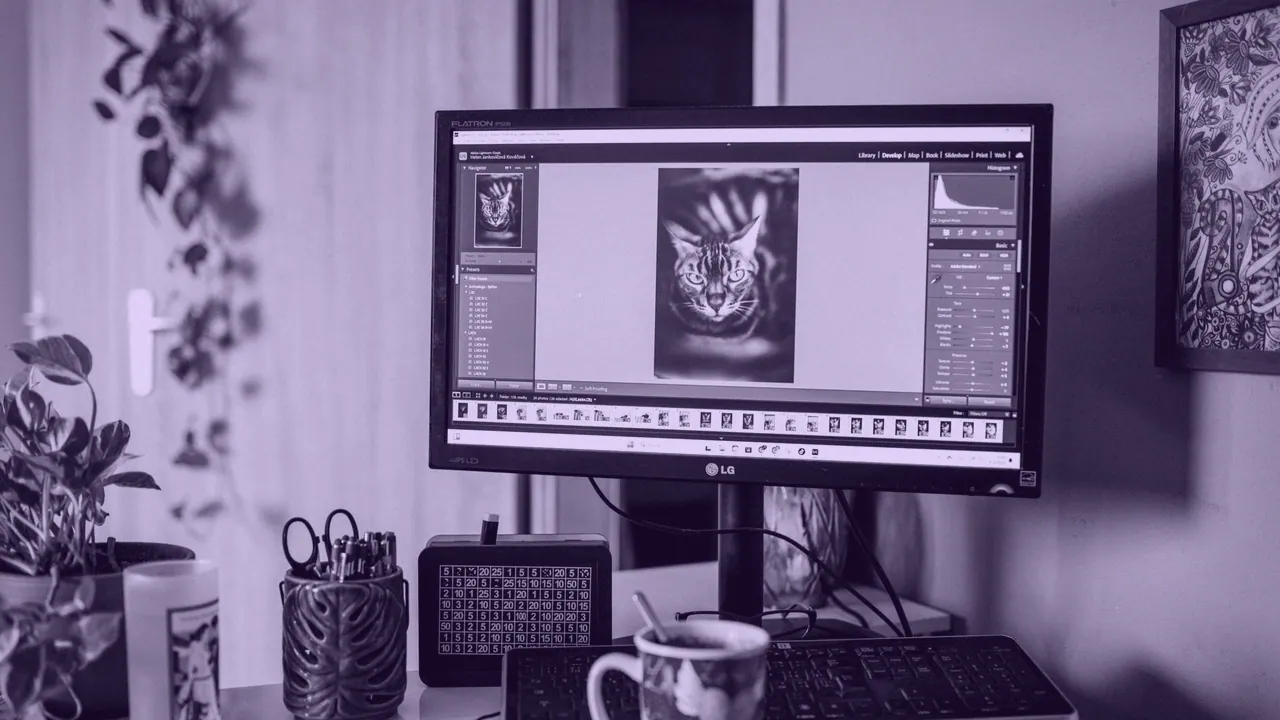
Three steps, and the order carries almost all of the quality. Crop, resize, export. Reversing the first two is the single commonest way a good source picture becomes a soft wallpaper, and it is a mistake nothing later in the process can undo.
Work out the target before you open the file
Work out the target first, because it decides both numbers you are about to type. A wallpaper has no standard size: it has the size of the screen it is going on, and that varies more than most people expect.
| Where it is going | Pixels | Aspect |
|---|---|---|
| PC, standard desktop | 1920 x 1080 | 16:9 |
| PC, common 27 inch | 2560 x 1440 | 16:9 |
| PC, 4K UHD | 3840 x 2160 | 16:9 |
| Ultrawide monitor | 3440 x 1440 | 21:9 |
| MacBook Pro 14 in | 3024 x 1964 | reported as 1512 x 982 |
| iMac 24 in | 4480 x 2520 | reported as 2240 x 1260 |
| iPhone 6.1 in standard | 1179 x 2556 | reported as 393 x 852 |
| iPad Pro 11 in | 1668 x 2388 | reported as 834 x 1194 |
Take the pixel column, never the reported column. macOS reports points, the panel has pixels, and a Retina display carries two pixels per point in each direction, so a file built to the reported number arrives at half resolution and gets upscaled to fill. That mechanism, not compression, is the commonest cause of a blurry Mac wallpaper.
Crop first, because a crop changes the shape and a resize cannot
Crop first because cropping is the only operation that changes the aspect ratio, and the aspect ratio is what decides which parts of the picture survive. Resize first and you have committed to a shape before you chose one, which forces a second resample when you finally crop, and every resample softens hard line work. Two passes soften it twice.
There is a second reason, and it is about composition rather than pixels. Cropping by hand means you decide what leaves the frame. Handing an uncropped image to the operating system means a scaler decides, and it decides by geometry: macOS scales a desktop picture to fill, cropping whichever axis is proportionally longer, unless you pick Fit To Screen or Stretch in the wallpaper settings. A scaler will cut a face in half without hesitating, because it cannot see one.
Set the crop tool to a fixed ratio, not a fixed pixel size. Fixed ratio lets you take the largest area of the original that has the right shape, which leaves the most pixels available for the single resize that follows.
Resize once, and downward wherever you can
Resize once, from the cropped region straight to the target dimensions, in a single operation. Downscaling discards information and looks clean, because every output pixel is built from several real input pixels. Upscaling has no real pixels to build from, so it invents them, and on the flat color and hard edges of anime art that invention is visible. If your crop is smaller than the target, that is an upscaling problem and not a resizing one, and it has a page of its own.
The practical rule follows from the arithmetic: 3840 x 2160 is four times the pixels of 1920 x 1080, not twice, so a 1080p source asked to fill a 4K panel is inventing three quarters of what you see. A source already larger than the target is always the better starting point, even when the difference looks trivial.
Export without destroying the flat color
Export in a format chosen for flat color, because flat color is what anime art is made of and it is exactly what a photographic codec handles worst.
| Format | Colors | Use it for |
|---|---|---|
| PNG | 16.7 million, lossless | flat color, line art, text |
| JPEG | 16.7 million, lossy | photographs, not cel color |
| WebP | lossy and lossless | both, at roughly 25 to 35% smaller than JPEG |
| AVIF | supports 10-bit | both, and 10-bit largely removes banding |
| GIF | 256 colors | short loops only, never a still wallpaper |
Banding is the visible stepping in what should be a smooth gradient, and it happens because 8-bit color has only 256 levels per channel. A large soft sky or a flat cel shaded background can cross fewer levels than it has pixels, which is why anime art bands so readily. One Windows behavior compounds it: Windows re-encodes desktop wallpaper as JPEG by default, which is why a clean PNG can look blocky once it is set. The quality of that re-encode is a JPEGImportQuality value under HKEY_CURRENT_USER\Control Panel\Desktop, set as a DWORD from 60 to 100.
A collage is one canvas, not several pictures
To make a wallpaper collage, open one canvas at the target size first and place the pictures into it, rather than arranging images and resizing the result afterward. A collage maker such as Canva does the same job and the same rule applies inside it: set the document dimensions before you add anything, because a layout composed at the wrong shape has to be squeezed to fit and every element in it degrades together.
On an iPhone the frame is not entirely yours. The lock screen reserves the top for the clock and the bottom for the flashlight and camera buttons, so the middle band is the only reliably visible area, and Depth Effect will push the clock behind a subject only when the image has a clear foreground. Compose the important faces in the middle third and leave the corners quiet.
The same crop does not travel between devices
A crop made for one screen is wrong on the next one, because the same picture is a different file on every screen it lands on. A Mac wallpaper at 5120 x 2880 downscales onto a 1920 x 1080 PC perfectly, since there are pixels to spare. The reverse fails, and a 16:9 desktop crop on a phone at 9:19.5 fails hardest of all: the file would need to be about 3.85 times as wide as the screen, so almost all of it lands off frame.
Finding the picture is the easy part. Keep the largest original you have, and cut a new crop per device from it rather than recycling one export everywhere.