An ultrawide screen crops an ordinary wallpaper to ribbons
SECTION
SCREEN SIZEANSWERS
ultrawide wallpapersREAD
5 minFIGURE
photographUltrawide wallpapers are files cut to an ultrawide aspect ratio, which in practice means 3440 x 1440 at 21:9 on a 34 inch panel, 2560 x 1080 at 21:9 on an entry ultrawide, and 5120 x 1440 at 32:9 on a 49 inch super ultrawide.
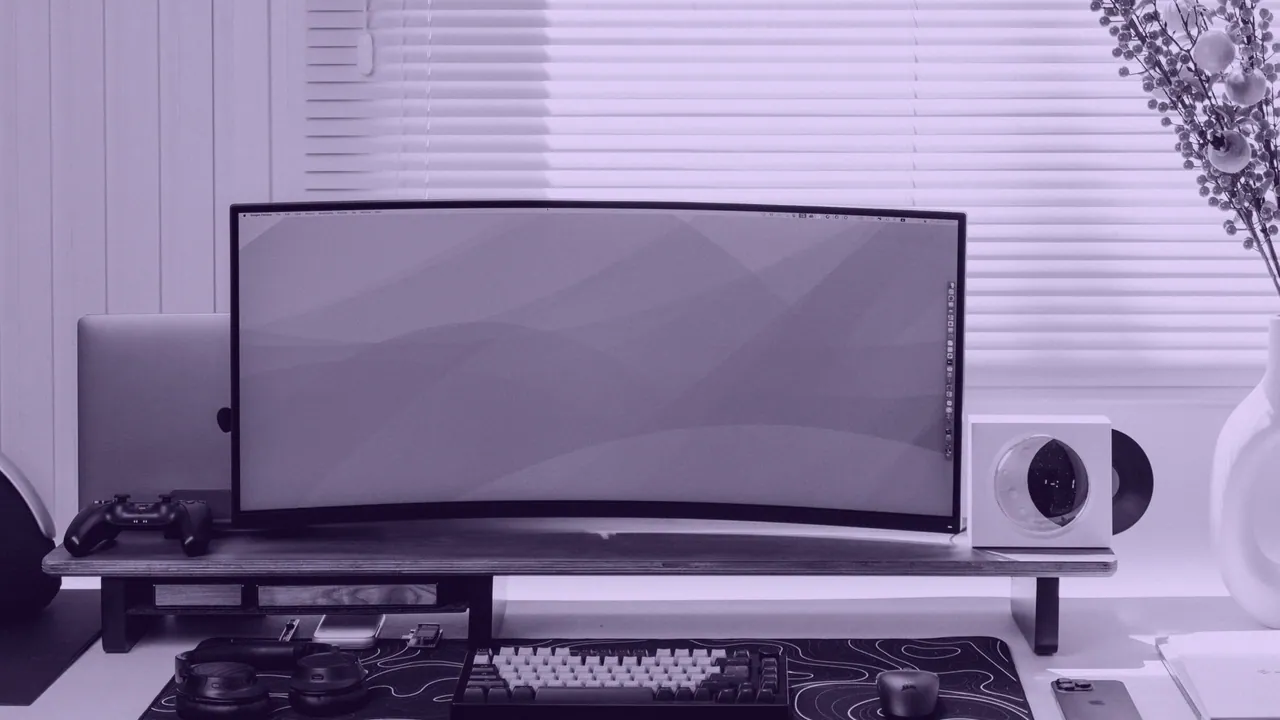
Those are shapes before they are sizes, and that is the whole difficulty. An ordinary 16:9 wallpaper on an ultrawide panel is not merely small, it is the wrong proportion, and the desktop resolves the mismatch by taking a horizontal ribbon out of the middle and throwing the rest away.
The ultrawide resolutions and what each one asks for
The ultrawide resolutions in circulation are three, and a file has to be cut to one of them rather than merely be large.
| Class | Pixels | Aspect | Panel it belongs to |
|---|---|---|---|
| Entry ultrawide | 2560 x 1080 | 21:9 | the 29 and 34 inch entry ultrawide |
| Standard ultrawide | 3440 x 1440 | 21:9 | the 34 inch ultrawide, the common one |
| Super ultrawide | 5120 x 1440 | 32:9 | the 49 inch Samsung class panel |
| 4K UHD, for comparison | 3840 x 2160 | 16:9 | an ordinary desktop monitor |
Read the fourth row against the second. A 4K file carries more total pixels than a 3440 x 1440 ultrawide file and is still the wrong shape, because 4K is 3840 x 2160 and the extra pixels stack in the wrong direction. Quantity does not substitute for proportion, which is why a search for the best ultrawide wallpapers in 4K welds two requirements into one phrase.
Why a 16:9 file cannot be made into a 21:9 one
A 16:9 file cannot be made into a 21:9 one because the pixels the wider shape needs at the left and right edges were never drawn. The ratios are 1.778 for 16:9, 2.389 for a 3440 x 1440 ultrawide and 3.556 for 5120 x 1440, and the desktop has only three ways to reconcile the difference.
- Fill the width and crop the height, which keeps about 74% of the picture's height and cuts roughly 13% from the top and 13% from the bottom.
- Fit the whole image and accept black pillars down both sides, which wastes most of the panel you paid for.
- Stretch the image to the panel, which widens every face, every circle and every straight line in it by a visible margin.
Filling is the least bad of the three and what a desktop does by default, but on a portrait-leaning composition it is fatal: the surviving ribbon is a band across the middle, and a character's head and feet go first. That is the sense in which an ultrawide screen crops an ordinary wallpaper to ribbons.
32:9 is not 21:9 with more pixels
A 32:9 panel is a different shape again, not a larger 21:9 one, and a 3440 x 1440 file does not cover it. At 3.556 the super ultrawide is nearly half as wide again in proportion as the 2.389 standard ultrawide, so a file cut for a 34 inch panel has to be enlarged before it can even reach both edges of a 49 inch one, and enlargement on flat cel color and hard line work is exactly the thing that shows.
One useful coincidence sits at this width: a 5120 x 1440 file is the same size a pair of 2560 x 1440 monitors wants, because two screens need one wide file and the widths simply add. Art made for the super ultrawide therefore works on a dual QHD desk, with a bezel where the panel had glass, which is why dual monitor sizes turn up filed under ultrawide.
What survives the shape is composition, not resolution
Composition decides whether an image survives an ultrawide crop, and no amount of resolution compensates for the wrong arrangement. Three properties predict success.
- Look for a low horizon and a wide setting, since landscape and cityscape art was composed across rather than up.
- Look for interest placed left and right with open space between it, because the middle of an ultrawide is mostly held by a window or a taskbar anyway.
- Look for art already delivered at 3440 x 1440 or 5120 x 1440 rather than cropped down from 16:9, since a crop from a 16:9 original has thrown away the height it needed to stay sharp.
Anime works against you here more than most genres. Key art is usually built around a single standing figure in a tall frame, which is the worst possible input for a 21:9 crop. Background art, the painted settings rather than the character sheets, is composed wide and holds up far better. Gaming panels are also frequently OLED, and on OLED the practical rule is that a dark image with no fixed bright element is the safe choice, since burn-in is driven by brightness, time and static content together.
Judging any wallpaper site before you download anything
Judging a wallpaper site involves two separate questions, and passing one says nothing about the other. The first is whether the download is what it claims to be: an image file should arrive as a single image, not an archive, not an installer, and not a page that asks you to run something first. The second is the licensing question, the harder of the two, because free to download and free to use are not the same thing. A site that offers a file has told you what its server permits, not what the rights holder permits.
This site hosts no wallpaper files and vouches for no third party, so treat any collection of anime art with no stated license as exactly that: unlicensed. Finding the picture is the easy part, and the rights question is the one that outlives it.
The same problem in the other direction, on a phone
A phone poses the identical mismatch turned through ninety degrees, because Android panels at 19.5:9 and 20:9 are as extreme vertically as an ultrawide is horizontally. Android also asks for a wallpaper wider than the screen so the launcher can scroll between home screens, roughly twice the screen width where parallax is supported, and many current launchers no longer scroll, in which case the extra width is cropped. A 16:9 file scaled to fill such a phone’s height has to be about 3.85 times as wide as the screen. Match the shape first and the pixel count second.
SHAPE BEFORE SIZE
An ultrawide wants 3440 x 1440 or 5120 x 1440. A larger 16:9 file is not a substitute for either, because the missing pixels are at the top and the bottom and nothing can put them back.